Rare Crocodilian Skull in the Jungle
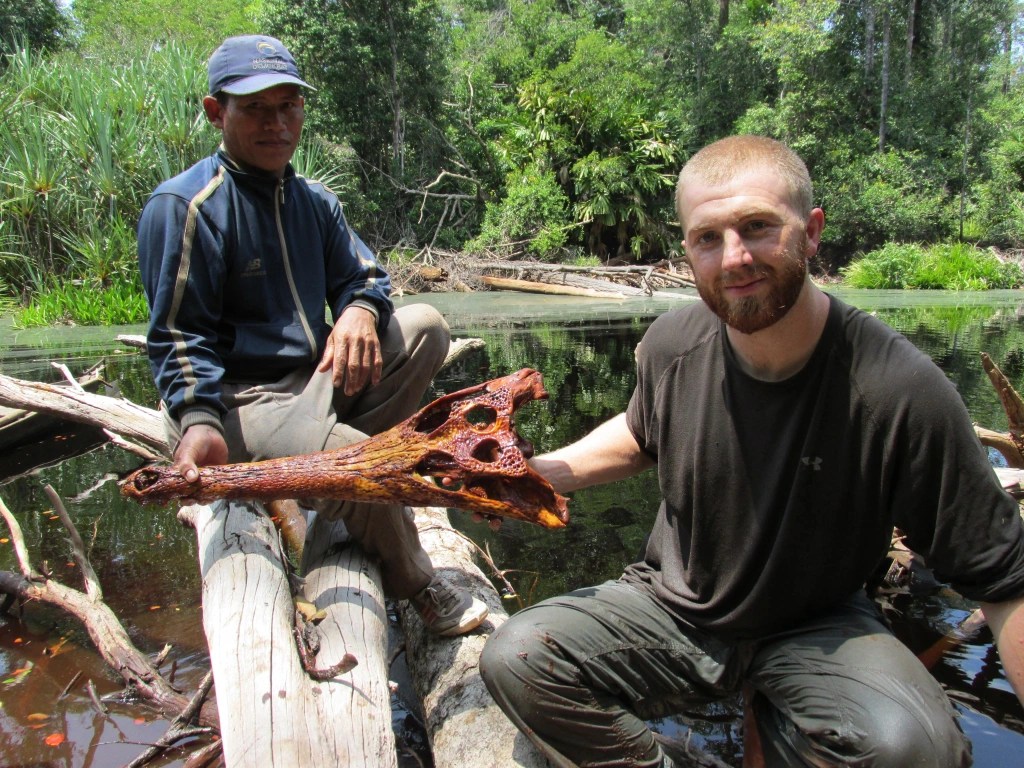
We had been portaging canoes through ephemeral swamp channels for two days after crossing from oil palm plantations into virgin forest along the east coast of Sumatra. We used the skeletons of dead trees to gain footing in mud that pulled us down to our waists and the tropical heat caused the mud to dry on our skin and clothes, forming what looked like pieces of shattered pottery. Members of the team could be seen wiping sweat from their eyes with wet and muddy sleeves, and during the peak heat of the day, nobody said a word for hours.
We had been in Sumatra for over a month with the goal of finding and surveying Sunda gharial populations (Tomistoma schlegelii). It was the focus of a portion of my doctoral dissertation, and we were traveling into the most remote stretch of jungle we had visited to date. We were entering the core zone of Berbak National Park in Jambi province. An intact patch of black water peat swamp forest, where Sumatran tiger populations, two species of crocodilians, Asian sun bears and probably king cobras still thrived.
On our third day, we paddled our canoes into a billabong where thin swamp channels opened up into a large black pond. I was being guided by a local, Kasno and his son, Andi. We pushed the canoe to shore along the edge of the swamp to wait for the rest of our party to arrive, which included a young undergraduate student from Indonesia, Aisyah Arimbi, a local national park guide, Sismanto and an additional canoe captain, Imran.
As we waited, Kasno noticed a small fragment of bone along the shoreline. I watched with curiosity as he picked at other pieces before pulling up a single vertebra.
“Buaya (crocodile) mister” he said in Indonesian. I was unsure and pressed him a bit. “Mungkin babi (Maybe it’s a pig)” I said.
“Tidak! (no!)” he said, emphasizing he was certain.
I watched as he proceeded to wade into the swamp digging for more bones. He swept his hands through decaying leaf matter for a short time before lifting a piece of the mandible of a very large crocodilian. My eyes grew and I waded into the swamp telling him “you are right pak (sir)”, “you are right”!
We both swept our hands through mud and leaf matter, slowly wading deeper into the swamp. As we reached our waist, we each had collected osteoderms, more vertebrae and other random fragments. The animal had died and its whole skeleton seemed to be left in place, the way you see a fully preserved raptor skeleton formed into a single fossilized piece of rock.
We pushed deeper into the swamp, and by that time the rest of our party had arrived. They watched with eyes fixated on Kasno and I. With each step deeper, more bones emerged. We formed a collection on the bank by passing them from one person to the other and we pushed deeper.
Kasno and I stood up to our necks and began taking deep breaths and diving down to sift through the muddy bottom. The substrate reminded me of a thin pancake batter, hardly thick enough to stay in my hands under water. While diving down, I opened my eyes to see what was out in the water, but the visibility was so limited that I couldn’t see Kasno swimming just a few meters away.
I came up gasping for air without anything in my hands and watched as Kasno took another dive. We continued to dive, one after the other, occasionally finding leg bones and other things. I estimate that I reached a point where I was diving to roughly nine or ten feet down. After coming up for air and moving to a position to stand, I stood dripping and waiting for Kasno to come to the surface. Moments later he emerged with a massive crocodile skull, measuring 65 cm in length. The skull was stained brown from the tannins in the water, but otherwise fully intact.
We cheered and moved to the bank, dripping from head to toe, and investigated the skull. It was in fact a member of the rare species, the Sunda gharial, which we had been searching for. We strapped the skull to a tarp and carried it for another week through the jungle for the rest of our surveys. We delivered it to the national park headquarters where it proudly sits in their entry in Jambi, Sumatra.
Kasno (seen in the picture) truly deserves the bulk of the credit for the find, but we did work together that day in the swamp to make the discovery. Without local knowledge and expertise, these expeditions would never be successful. Kasno, Sismanto, Andi and others still help us with our work in Berbak until this day. Hopefully you enjoy the story behind this skull. I will try to post more info on our YouTube channel: https://m.youtube.com/@emptyforests
Cypress Boars
This article appeared in the 2023 Winter edition of the Backcountry Journal, the official magazine of the Backcountry Hunters and Anglers organization.
Cocodrilos de Sumatra: entre la caza furtiva, la deforestación y la expansión de la palma de aceite
Written in Oikos, the magazine associated with UNAM’s Institute of Ecology, 2022.
Why is a Lonestar Native Treated as an Exotic?
This article first appeared in the March/April 2017 issue of Bugle magazine, the official magazine published by the Rocky Mountain Elk Foundation (RMEF). I copublished this article with Paul Queneau, the RMEF magazine editor.
Following in the footsteps of New Mexico wildlife
Written in the Santa Fe New Mexican newspaper, 2022
No Country For New Men
Written in American Waterfowler, November, 2015
Going Old School
Written in American Waterfowler, August/September, 2015
Panhandle Ducks-Dallas Safari Club Article (Published in 2015)
Kyle Shaney
Waterfowl numbers are at an all time high across the state of Texas this year and the forecast is looking good. https://www.biggame.org/dont-forget-the-panhandle-for-ducks-this-year/
Texas has received more than its fare share of rain this year. For duck hunters it could be a great opportunity to hunt areas that are normally bone dry. The High Plains Mallard Management (HPMM) unit encompasses all the North Texas prairie pothole country and with the rain we have had this year, those potholes are filling up. Small ponds and lakes throughout the region provide great loafing and stopping points for groups of migrating birds. It also means that small pockets of public land may become larger pockets, and areas that previously were devoid of activity might have large groups of ducks. Check out the TPWD public hunting land map (See link below) for ideas on where to go and don’t overlook US Army Corps of Engineers land either. There are also plenty of guided hunt options for those that would prefer.
If you decide to make a trip up to the panhandle this year it is worth your while to call a few TPWD biologists from the area. TPWD staff can be a huge help and they are typically happy to provide useful information. When you go, you can expect a variety of ducks in that region, including: mallards, redheads (early on), pintails, blue wing teal (early on), green wing teal and plenty of divers as well. The season for the HPMM is open Oct. 31st – Nov. 1st and Nov. 6th – Jan. 31st (See link below). Duck hunts in the panhandle can be an absolute blast and are certainly worth a trip this year.
Texas Public Hunting Information: https://tpwd.texas.gov/huntwild/hunt/public/
Texas Duck Hunting Regulations: https://tpwd.texas.gov/regulations/outdoor-annual/regs/animals/duck
TPWD Duck Hunting Forecast: https://tpwd.texas.gov/newsmedia/releases/?req=20150820b
 Empty Forests